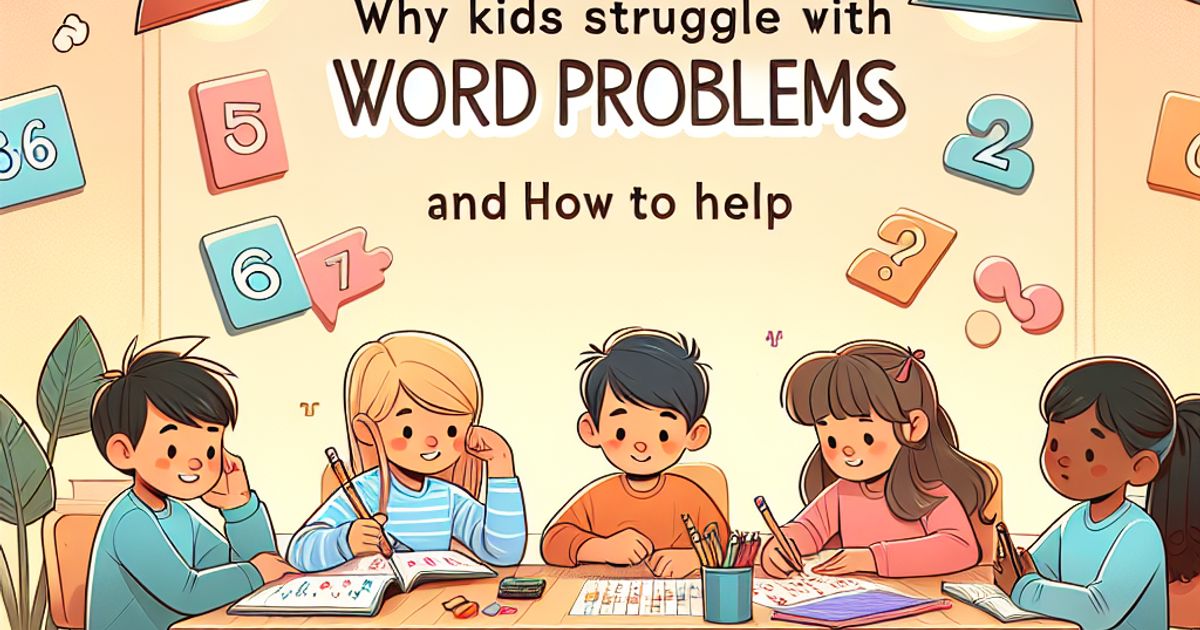
Word problems have been a source of frustration for children (and parents!) for generations. But here's the thing — solving word problems is not just about math. It's about comprehension, logic, and critical thinking, skills that impact every part of your child’s learning. If your child finds themselves stuck on questions like, "If Sarah bakes 12 cookies and gives 5 away, how many does she have left?", don't worry — you're not alone, and there are ways to help.
Today, children as young as first grade are being challenged with complex word problems that require more than basic addition or subtraction. Take this example from a Grade 1 International Math Olympiad: "A farmer has 10 apples. He sells 4 apples and then buys 6 more. How many apples does he have now?" It’s no wonder kids feel overwhelmed! Let’s explore why word problems are so tricky and, more importantly, how you can help your child tackle them with confidence.
What Makes Word Problems So Difficult for Kids?
Word problems combine math and reading comprehension, two skills that don’t always come naturally to young learners. Here are some common reasons why kids struggle:
- Language barriers: Even if your child knows the math, they may get tripped up by unfamiliar vocabulary or complex sentence structures.
- Context confusion: Many kids struggle to connect the problem to real-world scenarios. For example, "If a train leaves at 3 PM..." may feel abstract and unrelated to their daily life.
- Math anxiety: Research from Stanford University shows that parents' math anxiety can influence children, making them more likely to doubt their abilities when faced with challenges like word problems.
- Multi-step reasoning: Unlike simple calculations, word problems often require multiple steps, which can overwhelm children who struggle with working memory.
How Do I Help My Child Understand Word Problems?
Helping your child doesn’t require you to be a math expert. These strategies can make a big difference:
1. Break Down the Problem
Encourage your child to read the problem out loud and underline key information. For example, in the Grade 2 question, "If a school has 120 students and 40 join a field trip, how many are left in school?", guide them to underline important numbers and phrases like "120 students" and "40 join a field trip." This visual approach helps them focus on the essential details.
2. Use Real-Life Examples
Connect the math to everyday scenarios. For instance, ask, "If we have 6 apples and eat 2, how many are left?" Relating concepts to familiar situations makes the math less intimidating and more tangible.
3. Foster a Positive Mindset
Remind your child that mistakes are part of learning. Praise their effort and celebrate small wins, like successfully solving a single step of a multi-step problem. Confidence builds competence!
4. Practice with Fun Tools
Games can turn frustration into fun. Otterly Games offers educational tools like the Math Quiz for practicing word problems and Math Tank, where kids can solve engaging challenges tailored to their level. These resources keep children motivated and make practice feel like playtime.
What If My Child Still Feels Stuck?
If your child continues to struggle, it might be time to take a step back and review foundational skills. Tools like our Multiplication Table or Division Practice can help strengthen their core math abilities. Additionally, consider these tips:
- Talk to their teacher: Teachers can provide insights into your child’s specific challenges and suggest targeted strategies.
- Work in short bursts: Instead of lengthy sessions, try 10-15 minutes of focused practice daily to keep frustration levels low.
- Celebrate progress: Even small improvements are worth cheering for!
Are There Any Books to Help My Child with Word Problems?
Yes! Here are some excellent books designed to make math fun and accessible for kids:
- Bedtime Math: A Fun Excuse to Stay Up Late by Laura Overdeck
- Mind-Boggling Math: Fascinating Facts, Mysteries, and Dazzling Tricks by Joe Rhatigan
- Big Workbook: Grade 1-2 Math Skills by Scholastic
Some links are affiliate links — if you buy through them, we earn a small commission at no extra cost to you. We only recommend products we genuinely believe in.
How Can I Make Word Problems Less Stressful for My Child?
Here are some additional tips to make word problems feel less intimidating:
- Encourage visualization: Have your child draw pictures or diagrams to represent the problem. For example, if they’re solving “3 kids each have 2 apples,” they can draw three stick figures holding two apples each.
- Use manipulatives: Everyday items like coins, cereal, or toys can help children physically represent the problem and understand the math.
- Take breaks: If your child gets frustrated, it’s okay to pause and come back later. A fresh perspective can work wonders.
Your Child Can Master Word Problems!
Word problems can feel daunting at first, but with the right strategies, tools, and mindset, your child can develop the skills they need to succeed. Remember, it’s not about getting every problem right the first time — it’s about building confidence and a love for learning. Tools like Otterly Games’ Math Tank and Play Math Tank are fantastic ways to practice in a stress-free, engaging way.
Start small, celebrate every win, and watch your child grow into a confident problem-solver. And don’t forget to bookmark this guide so you can revisit these tips anytime!
Try Our Free Math & Time Tools
No download, no signup, no ads. Multiplication practice, division drills, clock lessons, and more — right in your browser.
Browse All Free Tools →