Times tables practice without a timer is a calmer way to learn multiplication facts: your child has as long as they need to think, check and try again. Speed usually grows once facts feel familiar, so it can wait until the facts are there.
That does not mean timed games are wrong. Plenty of children enjoy them. This guide is for the moments when the clock makes a child rush, guess or give up, and you want a gentler route. If you are comparing options, see our guide to free times tables games online too.
Why start without a timer
A fact can be remembered, or it can be worked out in a few seconds. A child who has not yet built that second route may feel stuck when a countdown is running. Taking the timer away lets them use the route they have, which is often counting in groups or using a nearby fact, and that is useful thinking, not cheating.
Begin with equal groups
Before any table, make sure 3 × 4 means "three groups of four" to your child. Build it with counters, buttons or pasta. Count 4, 8, 12 together, then turn the arrangement on its side to see four groups of three. That is why 3 × 4 and 4 × 3 give the same answer. The times-tables learning path has a worked example if you want a reference.
Patterns worth noticing
Patterns turn a long list into a few ideas. Let your child discover them first, then name them together.
| Table | Pattern to notice |
|---|---|
| 2s | Every answer is an even number; each is the number doubled. |
| 5s | Answers end in 5 or 0. |
| 10s | The answer is the number with a 0 at the end. |
| 9s (up to 9 × 10) | The two digits of each answer add up to 9: 18, 27, 36, 45 and so on. |
| 11s (up to 11 × 9) | The digit repeats: 11, 22, 33, 44 and so on. |
The 2s, 5s and 10s are a friendly place to start because the patterns are easy to spot. Save the 7s and 12s for later.
Build a new fact from a known one
Suppose your child knows 5 × 4 = 20 but is unsure about 6 × 4. Draw six rows of four dots. Five rows make 20, so cover the last row, then uncover it: one more row of four is 20 + 4 = 24.
Write the link down: 6 × 4 = (5 × 4) + 4. If the answer slips away later, they can rebuild it instead of starting from 1.
The same idea works for other facts. For 7 × 3, use 5 × 3 = 15 and add two more groups of 3 (6) to make 21.
A five-minute routine
- Choose one table (1 minute). Let your child pick. Ownership makes starting easier.
- Look for a pattern (1 minute). Read the facts together in the Multiplication Practice Study mode and ask what they notice.
- Try a few answers (2 minutes). Switch to Practice. It takes typed answers with no timer and no target score, and you can stop at any point. Counting or sketching is allowed.
- Revisit one (1 minute). Pick a fact that was tricky and rebuild it with objects or dots.
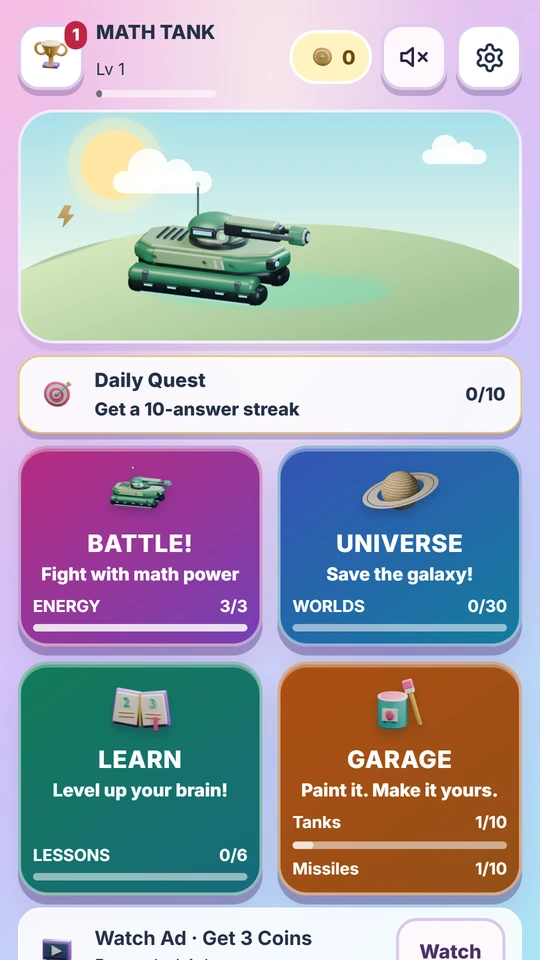
Celebrate effort and good explanations rather than speed. If you would like a game afterwards, Math Tank has guided lessons and an untimed Practice choice in your browser, alongside optional timed tank battles that you can leave for another day.
Common mistakes
- Adding instead of multiplying. If 6 × 4 becomes 10, go back to six groups of four and compare it with one group of six and one group of four.
- Practising every table in one go. Pick one table and leave the rest for other days.
- Treating a wrong answer as a failure. It shows which fact needs another look. Use it to try a pattern or draw dots.
- Only memorising the order. If your child can only recite a table from the start, mix the facts up gently once the pattern is solid.
When a timer can help
Once most facts are familiar and your child asks for a challenge, a short timed round can be a fun change. Keep it optional, stop if it stops being fun, and go back to untimed practice whenever it helps. Your child's teacher can tell you what they are expected to know and when.