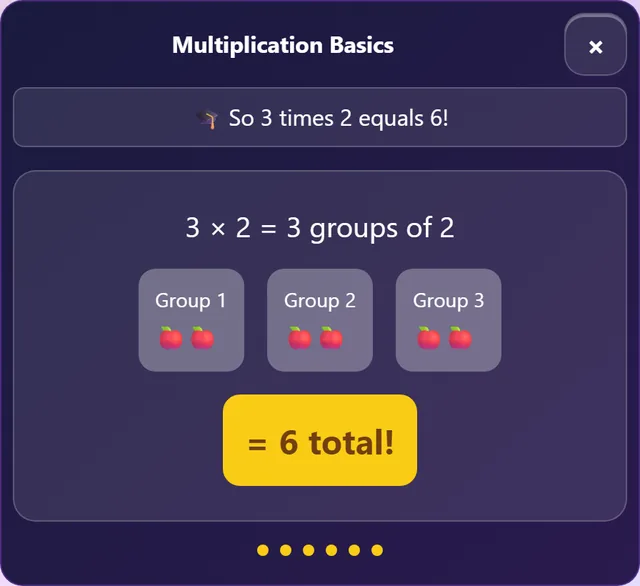
Division is often the first topic where children lose the thread. Math Tank begins with something every child understands: fair sharing. This article describes what its division lesson really shows, then adds two diagrams of our own, clearly labelled, for the ideas the lesson does not draw.
Play Math Tank Open Math Tank, choose Lessons & practice, then Division Concept.
Sharing first
"9 ÷ 3" can be read as "share 9 among 3". The numbers answer a question: how many does each get? Seeing this with objects makes the symbol a short way of writing something the child already knows how to do. If you have not yet read it, our division explained simply guide covers the same idea in more depth.
What the Math Tank lesson shows
In the free browser edition, open Lessons & practice and choose Division Concept (subtitle: "Share equally!"). The animation says "Let's share 9 apples among 3 friends", then:
- Nine apples appear, then panels for Friend 1, Friend 2 and Friend 3.
- The apples are dealt out one at a time, going round the friends in turn.
- The game announces "Each friend gets 3 apples!", then "So 9 divided by 3 equals 3!" with a yellow "= 3 each!" box.
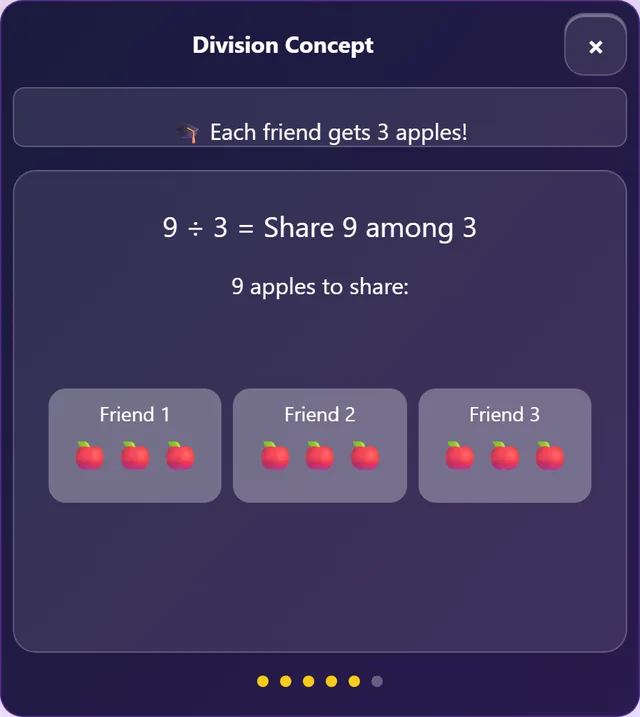
Dealing round and round is worth copying at home with real objects: it shows why the shares come out equal.
The practice screen
"Now You Try!" gives five questions. A question such as 9 ÷ 3 shows nine apples and the prompt to share them among 3 friends. The child types what each friend gets, and as they type, that many apples appear in each friend's panel, so the child can see the number they typed as an equal share. Questions in this lesson use two or three friends with small numbers like 6 ÷ 2, 12 ÷ 3 and 15 ÷ 3.
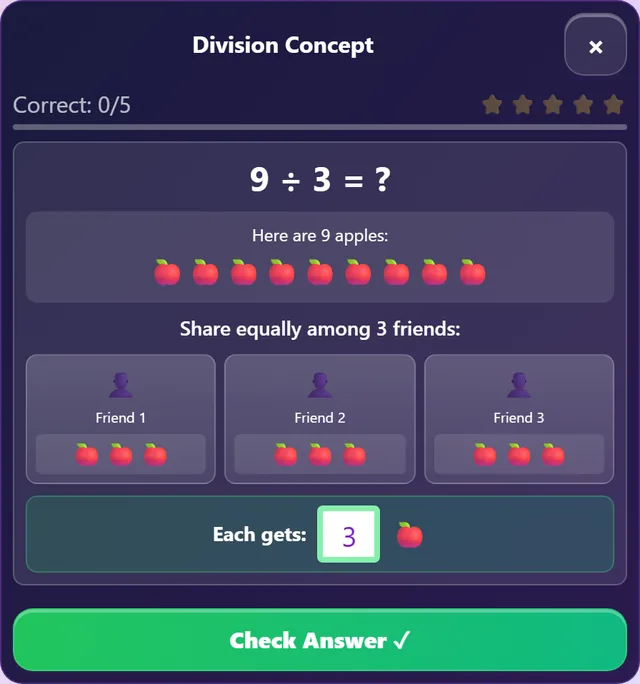
Try a practice round Five questions per round, with a Check Answer button.
A second meaning: grouping
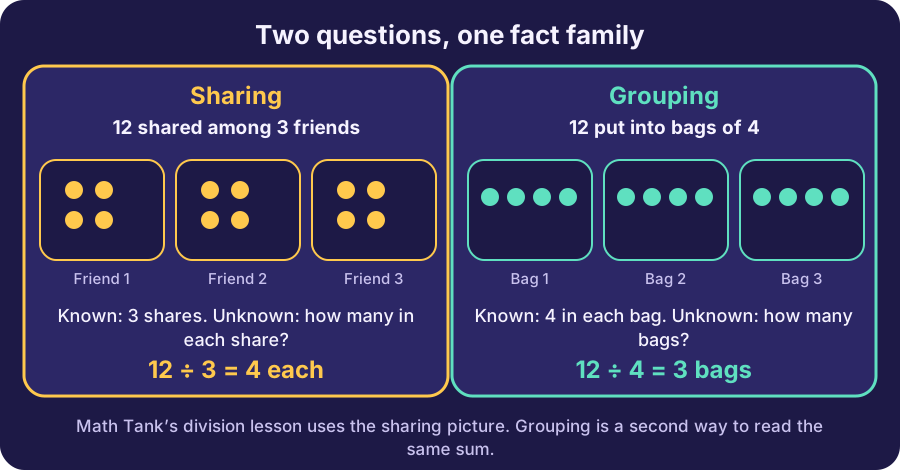
Sharing is one reading of division. The other is grouping: "I have 12 and put them in bags of 4. How many bags?" The game's Division Concept lesson uses sharing, so we have drawn grouping ourselves.
Division is multiplication backwards
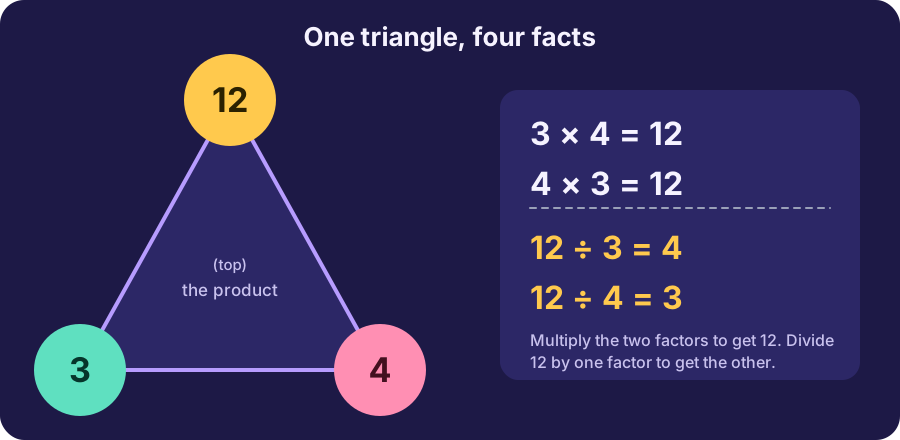
Because 3 groups of 4 make 12, division facts can be found from multiplication facts. A triangle with the product at the top and the two factors below gives four facts at once: 3 × 4 = 12, 4 × 3 = 12, 12 ÷ 3 = 4 and 12 ÷ 4 = 3. If your child is stuck on 12 ÷ 3, ask "3 times what makes 12?"
A simple practice plan
- Share real objects once, dealing round the plates.
- Play the Math Tank lesson and let your child predict each step.
- Print sharing-picture questions (modelled on Math Tank's sharing prompt) or a 3 times table division sheet.
- When remainders and long division come up, see how to teach long division step by step and the division learning path.
Progress in the free web edition is saved only in this browser. Keep rounds short and finish while it still feels good.