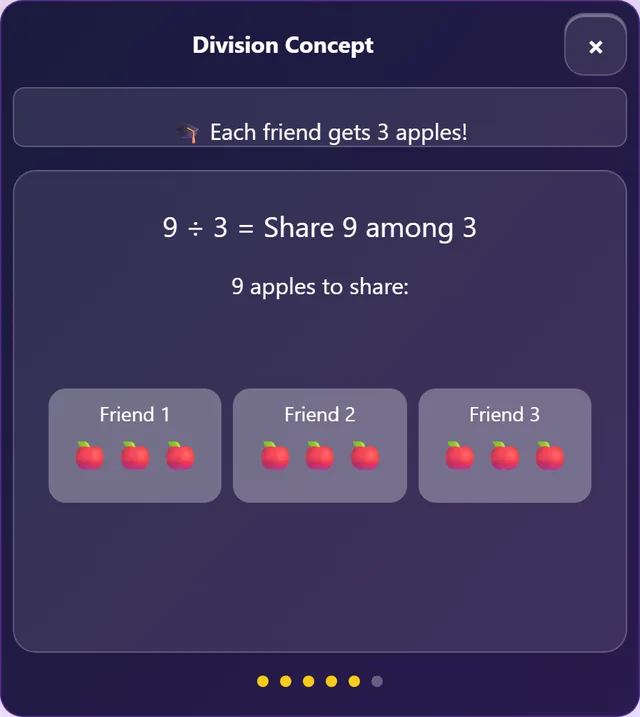
Many children meet multiplication as a table to memorise. Math Tank starts somewhere kinder: a few piles of apples. This article walks through what the game's first multiplication lesson actually shows, then adds one picture of our own that you can draw at the table.
Play Math Tank Open Math Tank, choose Lessons & practice, then Multiplication Basics.
Groups first, symbols second
"3 × 2" can be read as "3 groups of 2". That sentence is the whole idea. If a child can see three groups and count what is in them, the symbol stops being mysterious. Math Tank leans on exactly this reading in its first lesson.
What the Math Tank lesson shows
In the free browser edition, choose Lessons & practice and open Multiplication Basics (subtitle: "Groups of numbers!"). The lesson opens with "Ready to multiply?" and then animates its example, 3 × 2, one step at a time:
- Group 1 appears holding 2 apples, then Group 2, then Group 3.
- The game counts them all: "2 plus 2 plus 2 equals 6!"
- It states the result: "So 3 times 2 equals 6!" and shows a yellow "= 6 total!" box.
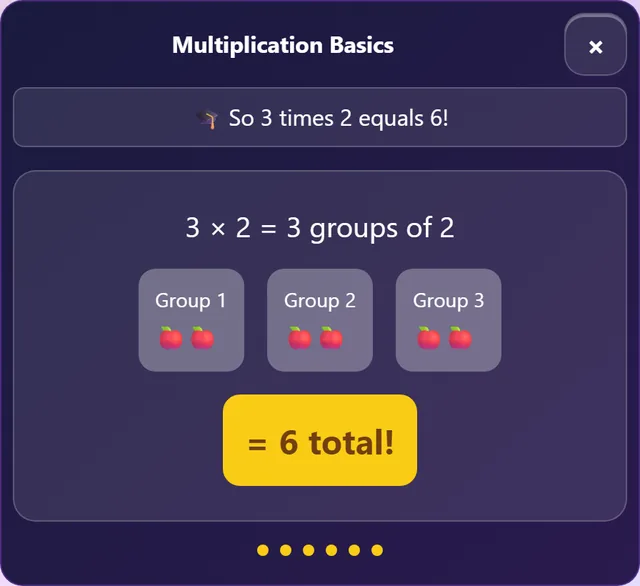
Notice the order: pictures, then repeated addition, then the multiplication sentence. This lesson uses equal groups, not a grid of rows and columns. Pause after step 1 and ask your child what they think will happen next.
Now you try: the practice screen
After the lesson, "Now You Try!" gives five questions. A question such as 3 × 4 asks the child to type the number of groups and the number in each group. As they type, a picture of that many groups of apples appears. Only after that do they type the total. Practice questions in this lesson use small numbers such as 2 × 3, 4 × 3 or 3 × 4.
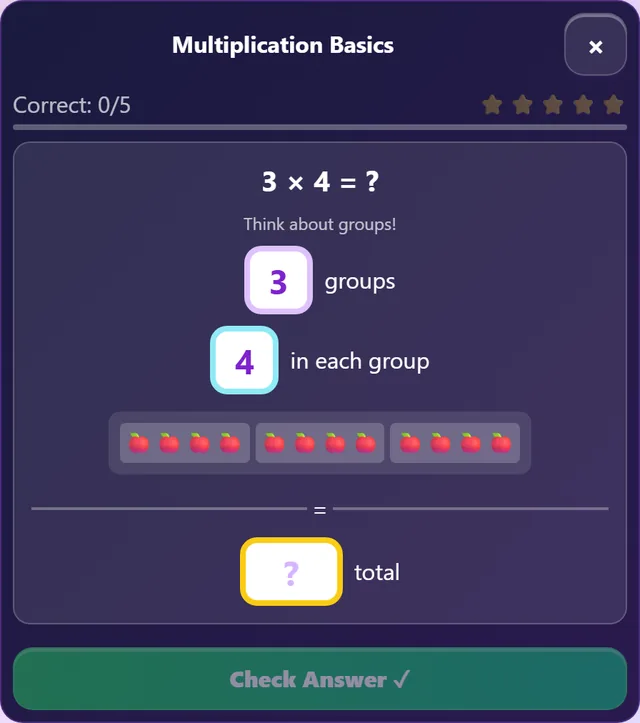
Try a practice round Five questions per round, with a Check Answer button.
Our extra picture: the array
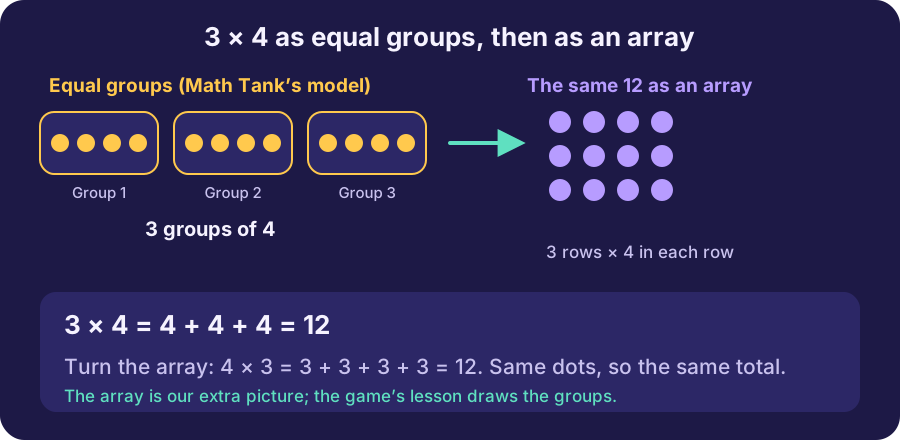
The game draws groups. We like to add one more view for homework: the same dots in rows. Three groups of 4 become 3 rows of 4, and turning the page sideways shows 4 rows of 3. That is why 3 × 4 and 4 × 3 both make 12.
Building a harder fact
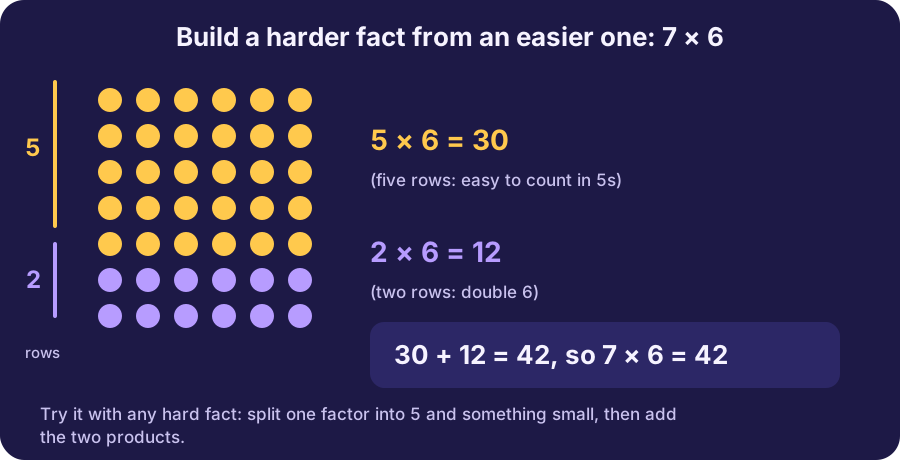
When a fact like 7 × 6 will not come, split one factor: 7 rows is 5 rows plus 2 rows. 5 × 6 = 30 and 2 × 6 = 12, so 7 × 6 = 42. Drawing it makes the trick visible.
A simple practice plan
- Play the lesson together once, narrating aloud.
- Draw one or two groups by hand: "4 groups of 3".
- Print a picture sheet: equal-group pictures, 10 questions. These sheets are modelled on Math Tank's picture prompt.
- For a table at a time, use the 3 times table sheet, or read times tables practice without a timer and the times tables learning path.
Math Tank's free web edition saves progress only in the browser you play in. Keep sessions short, and move on once explaining the groups feels easy.