The best way to practise telling time at home is usually small and regular: a few calm minutes with a real clock your child can see, tied to things that already happen in your day. No single method suits every child, so treat this guide as a menu rather than a programme.
It assumes your child can already find the numbers 1 to 12 and tell the short hand from the long hand. If not, begin with our step-by-step guide to teaching a child to tell time, then come back here for practice routines.
Little and often, one idea at a time
Clock reading has several layers: the hour hand, the minute hand, counting in fives, and phrases such as "half past" and "quarter to". Practising all of them at once is a common reason it feels stuck. Choose one layer, practise it for a few days, and add the next only when the first feels easy.
A sensible order is whole hours, half past, quarter past and quarter to, five-minute steps, then single minutes. Your child's school may use a different order, so ask their teacher what is being covered and follow that where it differs.
Put a real clock where your child can see it
Practice sticks better when the clock is part of the room rather than a task on the table.
- Hang an analogue clock in the kitchen or bedroom, at your child's eye level if you can.
- Make a paper plate clock with two card hands and a split pin, so your child can set times with their own hands.
- Read the hands first, then check on a digital clock or phone. That keeps the analogue clock doing the thinking.
A five-minute routine you can repeat
This is a suggestion, not a rule. Stop sooner if your child is tired, and repeat the same step on another day if it needs it.
- Look (1 minute). Glance at the real clock together. Ask which hand tells the hour and which counts the minutes.
- Set it (1 minute). Say a time such as "7 o'clock" or "half past 3" and let your child set it on the paper plate clock.
- Read it (1 minute). Swap roles. You set the hands, and your child says the time. Make one mistake on purpose and see whether they spot it.
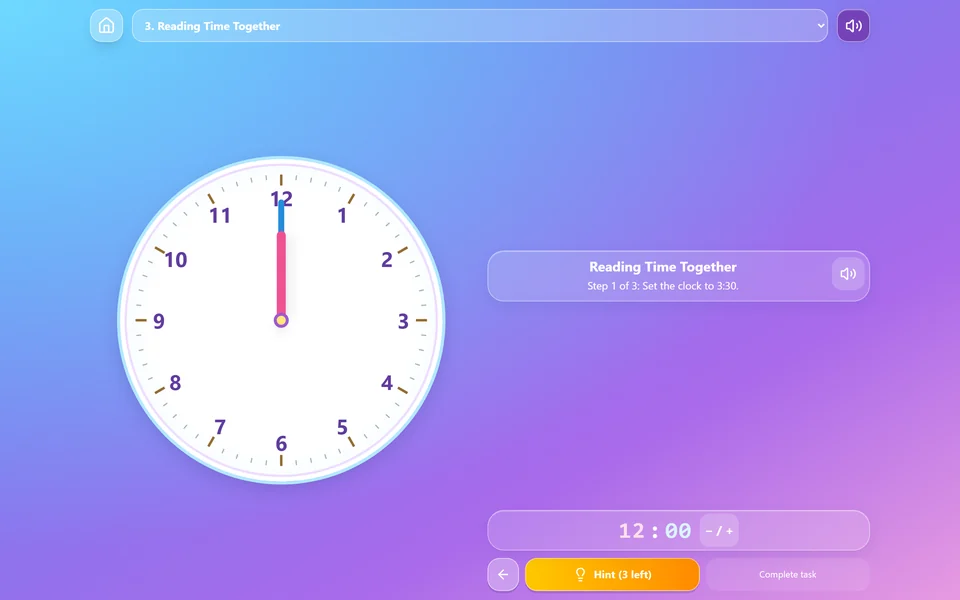
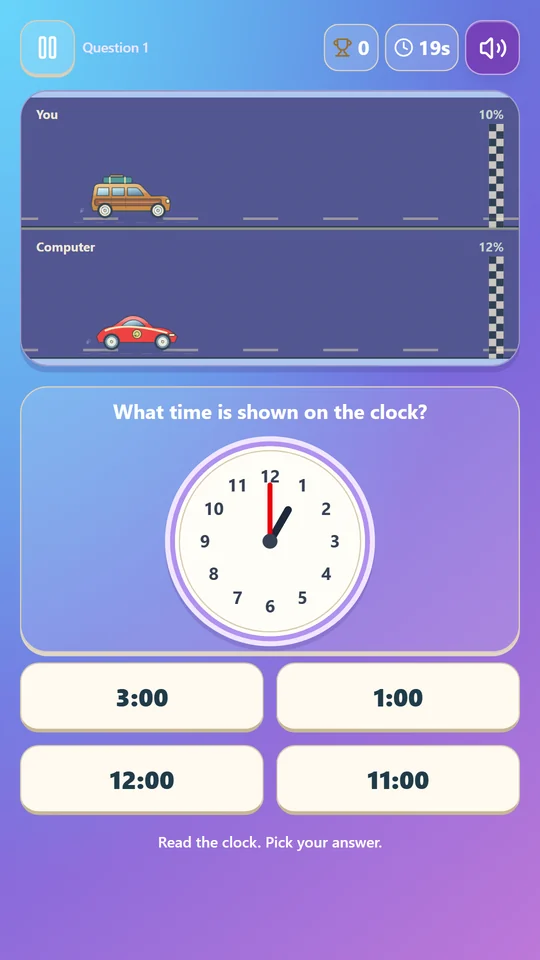
- Try a tool (1 minute). Open Clock Lessons, pick one of the five levels yourself, and answer three questions together. Ask your child to explain one answer out loud.
- Link it to the day (1 minute). Ask, "What do we usually do at this time?" Connecting the clock to breakfast, school or bedtime gives the numbers a meaning.
Everyday moments that count as practice
You do not need extra sessions for these. They fit into what you are already doing:
- "Bedtime is at half past seven. Where will the long hand be pointing?"
- "We leave for school at quarter to eight. Can you show me on the clock?"
- "It is 5:15 now and dinner is in 30 minutes. What will the clock say?"
- Let your child be the family time-keeper for one routine, such as getting shoes on.
Keep it light
One question at a time is plenty. If it starts to feel like a test, put the clock away and try again tomorrow.
A worked example: reading 4:35
1. Hour first. The short hand has passed the 4 but has not reached the 5, so the hour is 4.
2. Count the minutes. The long hand points to the 7. Count in fives from the 12: 5, 10, 15, 20, 25, 30, 35. That is 35 minutes.
3. Say it. "Four thirty-five." Later you can add "twenty-five to five".
A quick check: 35 minutes is a little more than half an hour, so the short hand should sit just past the halfway point between the 4 and the 5. If it does not, look again at which hand is which.
Common mistakes to avoid
- Reading the nearest hour. At 4:50 the short hand looks close to 5, but it is still 4:50. The hour is the number the short hand has passed.
- Reading the 7 as seven minutes. The numbers are minute markers in groups of five. Practise counting in fives before combining it with the clock.
- Mixing up the hands. Colour the short hand on a paper clock, or say "short is the hour" each time.
- Practising too long. Several short turns beat one long, tiring one.
When to move on
Move to the next layer when your child can read the current one on a few different days without hints, even if they are a little slow. Stay longer if they are guessing or getting upset. Telling time takes many children months, and your child's teacher is the best guide to what they need next.