Olympiad-style maths questions ask children to think in a slightly different shape from everyday homework: a short story, a hidden pattern, a picture to read. Most families do not need a big plan to practise that. They need a rhythm that is small enough to survive a busy week.
This guide describes one such rhythm for Classes 1 to 5, built around Space Academy, our free browser game of rocket-building maths missions. Space Academy is original Otterly Games practice written in an Olympiad style. It is not an official Olympiad, it is not affiliated with any exam provider, and it is not complete exam preparation.
Open Space Academy Free in your browser. Every question is untimed and has a hint.
Why a routine beats a cram
A child who meets two or three unfamiliar questions on a calm evening may be a gentler way to start than a long paper once a month. Short, regular sessions also make it easy to notice patterns: perhaps fractions feel fine but word problems get skipped. We cannot promise that any routine will raise a score, but small sessions keep practice friendly, and a friendly session is one a child will return to.
A weekly rhythm you can keep
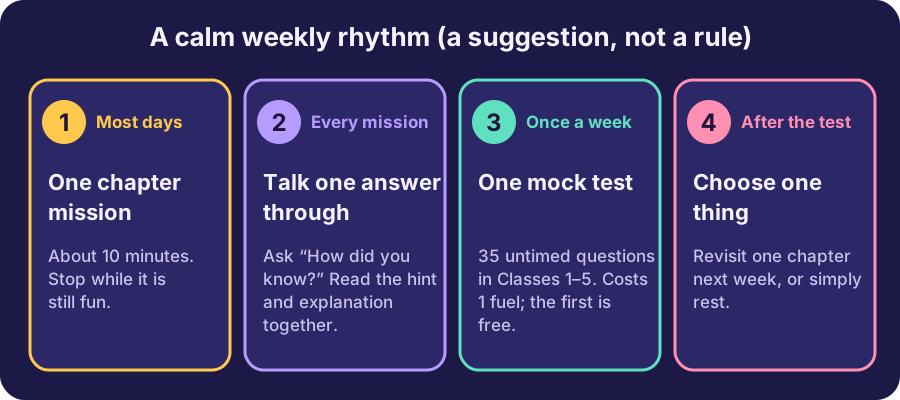
- Most days: one chapter mission, about ten minutes. Stop while it is still fun, even if you could squeeze in more.
- Every mission: talk one answer through. Ask "How did you know?" and read the hint or explanation together. Explaining is where understanding shows up.
- Once a week: one mock test. In Classes 1 to 5 a mock test is 35 questions, untimed. It costs one fuel, the first is free, and fuel refills every day.
- After the test: choose one thing. Pick one chapter to revisit next week, or simply rest.
A worked example: the bar model
Here is an original question of the kind a Class 3 child might meet. It is not from the game or an exam; we wrote it to show the thinking.
Pip has 12 star stickers. Roo has 3 times as many. How many stickers do they have altogether?
- Draw one bar for Pip and label it 12.
- "3 times as many" means Roo's bar is three of those bars, each worth 12.
- Roo has 3 × 12 = 36.
- Altogether: 12 + 36 = 48. Another way to see it: there are 4 equal bars of 12, and 4 × 12 = 48.
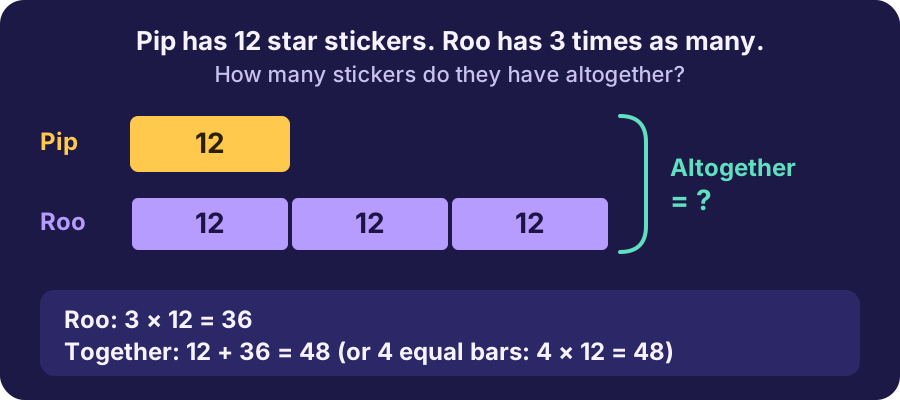
Notice that the picture did the hard part. Once the bars are drawn, the multiplication is easy. Asking "can you draw it?" is one of the most useful prompts you have. If a child answers 15 (12 + 3), they added instead of multiplying; draw the bars together and let them spot it.
Open Space Academy Choose Class 3, then practise operations through the “Add, take, times” part or the Systems Check topics.
Choosing a class and a chapter
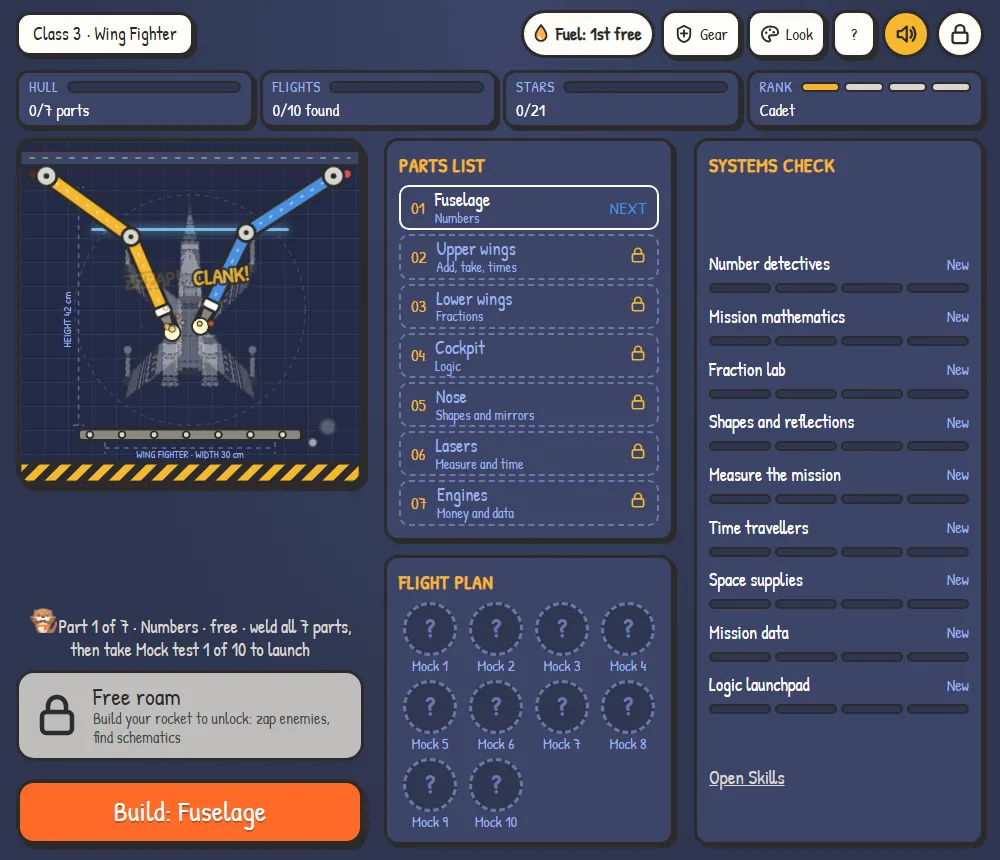
The first time Space Academy opens, it asks for a class: Class 1 (a Classic Rocket), Class 2 (Twin Shuttle), Class 3 (Wing Fighter), Class 4 (Hex Interceptor) or Class 5 (Wedge Flagship). Younger learners have Pre-primary 1 and 2. Pick the class that matches school, or one lower if confidence is low. Each class builds its rocket from chapters; in Class 3 the parts are Numbers, Add/take/times, Fractions, Logic, Shapes and mirrors, Measure and time, and Money and data.
Each chapter also has its own page with sample questions: for example the Class 3 operations chapter, and the full class and chapter index. Progress in the game is saved only in this browser, with no account.
Using mock tests gently
A mock test is practice, not a verdict. Do it on a quiet day, take your time, use the hints and talk through answers together, and treat the result as a list of things to look at together. The mock test guide and the Olympiad preparation overview explain how the tests are organised. For a spread of chapters, open Space Academy, choose Class 3 and work towards a mock-test flight.
Paper follow-up and what to expect
Some children think more clearly with a pencil. The worksheet builder can make an Olympiad-style sheet with a separate answer key containing worked explanations:
- Class 3 operations, 10 questions
- A full Class 3 practice paper, level 2 (35 questions in Classes 1 to 4, 50 in Class 5)
These are original Otterly questions in an Olympiad style, not official papers from any organisation. Keep the tone light, celebrate good reasoning even when the answer is wrong, and remember that a few relaxed missions a week is a perfectly good plan.