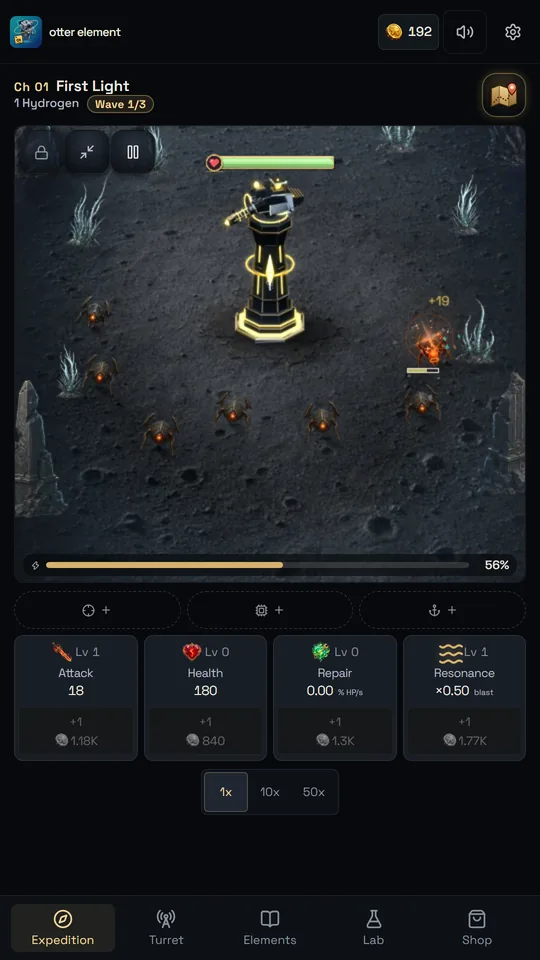
Atoms, elements and molecules are often used as if they mean the same thing. They do not, and a clear picture makes the difference easy. This guide uses the first two elements, Hydrogen and Helium, as examples, and ends with an honest note about what a game can teach.
Open the Otter Element preview The free preview lets you discover Hydrogen and see its atom.
Atoms
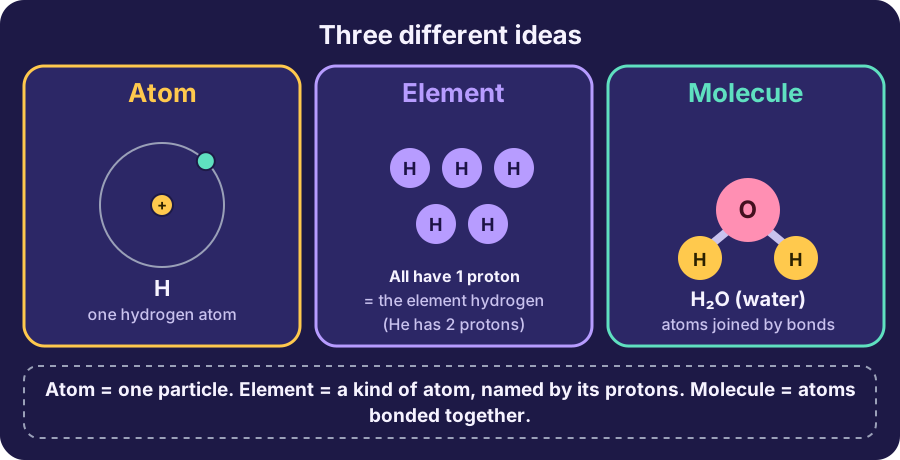
An atom is a single tiny particle of matter. Every atom has a centre called the nucleus, made of protons and (usually) neutrons, with electrons around it. Protons carry a positive charge and electrons a negative one; neutrons have none.
Elements
An element is a kind of atom, and the kind is set by the number of protons. Every atom with 1 proton is hydrogen; every atom with 2 protons is helium. That number is the atomic number, and the periodic table is ordered by it.
Molecules
A molecule is two or more atoms joined together. Two hydrogen atoms form a hydrogen molecule, H₂. Two hydrogen atoms and one oxygen atom form water, H₂O. The little number says how many atoms of that element are present.
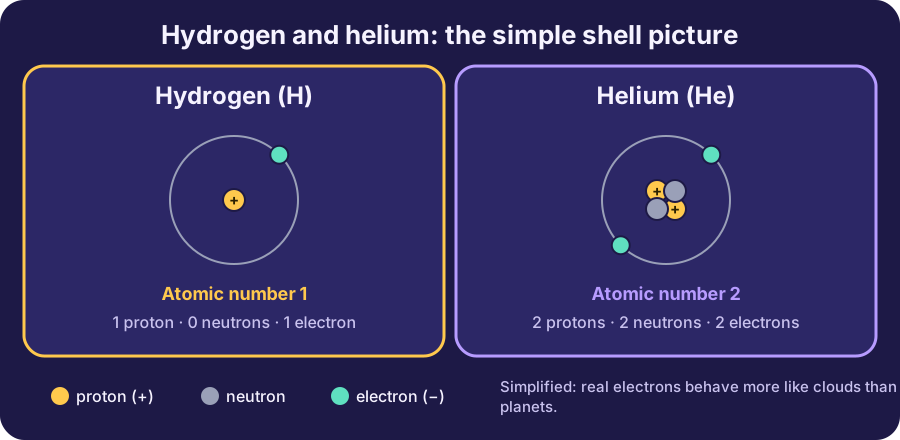
Hydrogen and helium side by side
Hydrogen has 1 proton, 0 neutrons and 1 electron in the most common form. Helium has 2 protons, 2 neutrons and 2 electrons, and its first electron shell is full. Diagrams like the one below are a simple model; real electrons behave more like clouds than orbiting planets.
What Otter Element shows
In the free preview, clearing the first node discovers Hydrogen and shows a card with its atom: 1 proton, 0 neutrons, 1 electron.
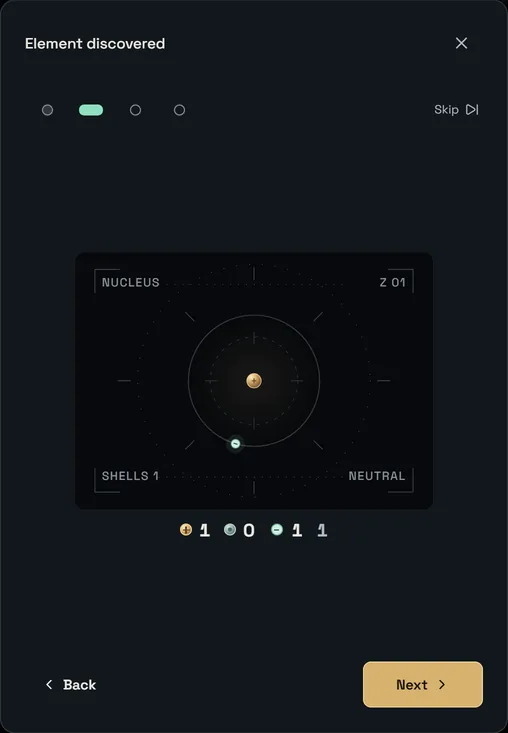
The Elements tab then shows a periodic table with Hydrogen highlighted. The preview contains only the first two elements; see the beginner guide for a walk-through.
What the game simplifies
Otter Element is a game, not a chemistry simulator. Its powers, "fuse" recipes and the way molecules fit into parts of a tower are designed for play and are schematic, not real chemical reactions. The practice bench on the preview page, for example, is a toy: it spends nothing and unlocks nothing. The real facts in the game are the atomic structures and the order of the periodic table; the gameplay built around them is invented. For real chemistry, look to a science teacher or textbook, and use the game as something to spark curiosity.
Ways to explore together
- Ask "how many protons?" for hydrogen and for helium, then check the numbers against the diagrams above.
- Draw water as one big atom and two small atoms joined together, and ask what would change if you removed one.
- Look at a printed periodic table and find the first two boxes, the ones the preview opens.
- Keep it playful: a child who is curious about the words is already doing science, even if the electron model gets refined later at school.
None of this requires any special knowledge from you. Reading one short diagram together is enough to turn three confusing words into three useful ones.